Wednesday, February 29, 2012
Tuesday, February 28, 2012
Getting Started
The participants didn't know where we were or what time we were starting. That's just a small detail... lol!
We saw a small town in action and by 9am everyone arrived who would be coming for the day. Someone, somewhere in Rankin was able to direct them to the right spot. We expected 16 and saw 14. We heard that 2 individuals may have faced travel issues because one of First Air's jets needed repair up north and everything got bumped around. No one knew if they might show up late or if they may not come at all. I imagine I will see them tomorrow if they are coming.
Today was our chance to get to know the communities. Most of our morning was filled with discussion about the infrastructure, issues and trends that influenced their roles within the community. We spent the afternoon introducing solid waste concepts and good landfill practices.
My insights from the morning's discussion:
One of the fellows promised me he would teach me to sea kayak... I would love to do it! I said I heard you couldn't go out until you learned to do a roll... he asked, you mean an 'eskimo roll'? He laughed and said, no, you don't want to do that if you don't have to... I knew there was something off about the thought as soon as it came out of my mouth... I can't imagine anyone would want to get wet out here. Another fellow let me know that you would end up rolling if you were too stiff -- but if you kept a flexible body, you wouldn't have trouble. My 'teacher' takes his kayak out hunting. He says he hunts seal, bow whale and even polar bear... I asked him how he would get a polar bear home on his kayak. He said he would work day and night... I assume that means many trips? I think I'll ask him more about that tomorrow...
Arnie said the biggest polar bears live out on the ice. They wander around the edge of the flow where they can find seal and they rarely come in to land.
I was reading the paper up here today. Roald Amundsen, an early northern explorer, credited his time in Gjoa Haven for giving him the skills to make it through the Northwest Passage. The more chances I get to chat, the more I realize that there is a true 'art' required to embrace life in these northern communities. The fellow from Gjoa Haven spoke of their seasons as -- the 'light' and 'dark' season. When he mentioned that we were heading into the time of 'light' his face lit up in a way that expressed true joy.
Jim took some pictures today, I'll post them tomorrow.
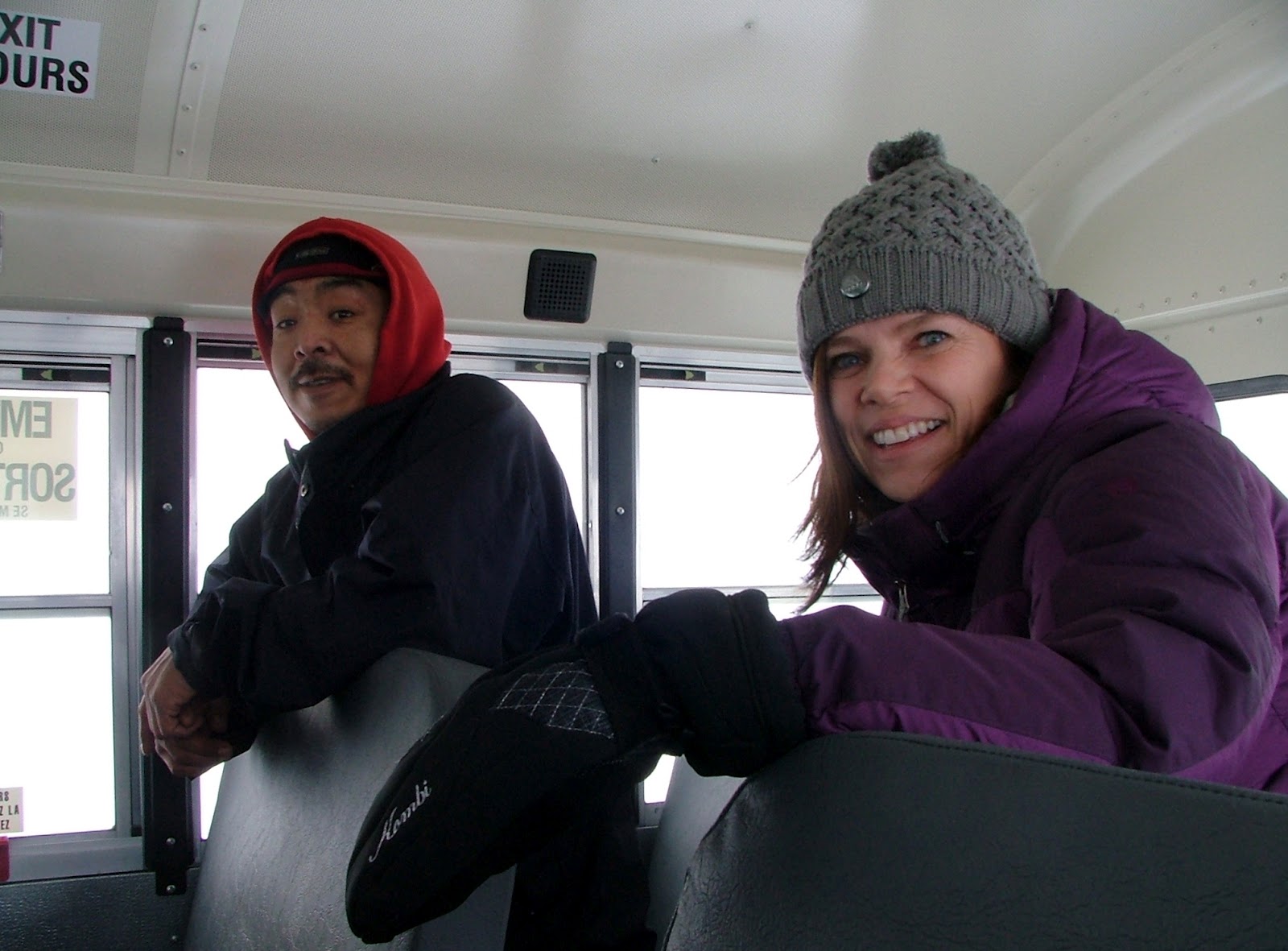
We saw a small town in action and by 9am everyone arrived who would be coming for the day. Someone, somewhere in Rankin was able to direct them to the right spot. We expected 16 and saw 14. We heard that 2 individuals may have faced travel issues because one of First Air's jets needed repair up north and everything got bumped around. No one knew if they might show up late or if they may not come at all. I imagine I will see them tomorrow if they are coming.
Today was our chance to get to know the communities. Most of our morning was filled with discussion about the infrastructure, issues and trends that influenced their roles within the community. We spent the afternoon introducing solid waste concepts and good landfill practices.
My insights from the morning's discussion:
- Concern for the issues and community involvement in finding solutions is alive in many small communities. Cambridge Bay was facing public concern over a very large and unsightly dump site. They accomplished change with the help of many volunteer hours from their community members. People came out to build, clean and support any way they could.
- In a northern environment it is very challenging to do all the 'right' things. Landfill cover is a good example. Sometimes good cover (crushed rock, soil) is not available and needs to be made by crushing rock. This solution is too costly for some communities to bear.
- Polar bear control is an issue. The bears are attracted to the landfill sites. It's illegal and dangerous for them to feed at the landfill. Fencing is not effective to stop them. Some communities are burning landfill waste in an effort to deter the bears. Not the best situation, but better than the alternative.
- Historical problems are difficult to solve... some communities have commercial or industrial waste onsite that was received in the past with no way to identify it.
- Many landfills are uncontrolled.
One of the fellows promised me he would teach me to sea kayak... I would love to do it! I said I heard you couldn't go out until you learned to do a roll... he asked, you mean an 'eskimo roll'? He laughed and said, no, you don't want to do that if you don't have to... I knew there was something off about the thought as soon as it came out of my mouth... I can't imagine anyone would want to get wet out here. Another fellow let me know that you would end up rolling if you were too stiff -- but if you kept a flexible body, you wouldn't have trouble. My 'teacher' takes his kayak out hunting. He says he hunts seal, bow whale and even polar bear... I asked him how he would get a polar bear home on his kayak. He said he would work day and night... I assume that means many trips? I think I'll ask him more about that tomorrow...
Arnie said the biggest polar bears live out on the ice. They wander around the edge of the flow where they can find seal and they rarely come in to land.
I was reading the paper up here today. Roald Amundsen, an early northern explorer, credited his time in Gjoa Haven for giving him the skills to make it through the Northwest Passage. The more chances I get to chat, the more I realize that there is a true 'art' required to embrace life in these northern communities. The fellow from Gjoa Haven spoke of their seasons as -- the 'light' and 'dark' season. When he mentioned that we were heading into the time of 'light' his face lit up in a way that expressed true joy.
Jim took some pictures today, I'll post them tomorrow.
Monday, February 27, 2012
Arrival & Getting Climatized
We arrived this afternoon at 1:40pm. The flights worked out well -- for anyone ever heading this way -- First Air serves HOT MEALS, I haven't had a hot meal on a plane for so long I can't remember when! All our boxes arrived without a hiccup. It was a relief for me because I needed to identify some as 'excess' when we checked in, it was hard to say what I was OK to go without and once I had I regretted it. Jim even brought his guitar and it was the first thing unloaded -- not a scratch...
We met the crew from Cambridge Bay at the airport, very friendly! They saw Dwayne's jacket and introduced themselves to us. Mike said we have representation from the two most northern communities in Nunavut in our course... Gjoa Haven and Resolute Bay.
Arnie, the Utility Foreman for Rankin Inlet picked us up at the airport, took us to the hotel, then the fire hall (where the training will take place) and then on a guided tour of the whole town -- including the landfill, of course.
Ambrose is the fire chief and he has offered to make us coffee and bring in cookies each morning. Although he was a bit surprised by our arrival, he didn't hesitate and was ready to accomodate anything we needed. The room will be perfect -- it's spacious and equipped with everything we need.
The town of Rankin has over 2000 people and 847 vehicles. Many people use all terrain vehicles or snowmobiles as their primary means of transportation. It seems weird for snowmobiles to plow along the main street amongst the cars... but why not?
The town has an underground utilidor serving water to a large section of the community. Unlike Iqaluit, Rankin has a little more topsoil, gravel and crushed rock around. The utilidor is contructed from a material that has some flexibility in order to deal with shifts in the permafrost.
Tomorrow we will be talking about the landfill in each of the communities attending (12) and touring Rankin's landfill with the participants. I can't wait to hear more about the conditions everyone faces.
More tomorrow...
Sunday, February 26, 2012
Municipal Hazardous Waste - 2 in Rankin Inlet
Here we go again!
The Edmonton Waste Management Centre of Excellence is working with the Municipal Training Organization and the Department of Environment for Nunavut to bring Municipal Hazardous Waste Training to municipalities across the north. This time 16 individuals from 12 northern communities will participate in 11 days of training -- 5 in Rankin Inlet and 6 in Edmonton, where they will explore methods to manage hazardous waste within their community landfills.
Jim Lapp, Dwayne Christenson and myself (Colleen Starchuk) will head to Rankin Inlet tomorrow. Training participants will venture to Edmonton for the 2nd phase of their training experience on March 25.
While we can never be sure until we begin discussions, the training team recognizes that 'waste management' in these remote communities is a different ballgame than it is in the south. As we found out from our last trek, a rocky land mass, limited shipping opportunities and year round ground frost are just some of the factors that make 'typical' methods impossible.
As before, the only thing we can all be sure of is that this northern trek will provide us as much learning as we are hoping to provide. Our last foray exposed us to rich culture, a strong sense of community and greater perspective about the challenges of supporting a remote community.
More to come as the adventure unfolds...
Saturday, February 19, 2011
HHW Last Day!
Our last day of training, but definitely not an easy one. We tackled a preview of Ozone Depleting Substances today, moving through some concepts that we were even questioning as instructors.
Full agreement by everyone: the best part of the day was the giveaways. Thanks to Steve's generosity we gave away the safety gear and the remaining prizes. The gear put a smile on everyone's face and created a lot of excitement in the room.
As a wrap-up we talked about some of the things that the participants felt they could do in their communities now. Here are some of the answers we received:
So far we have received kudos for supporting this training initiative. Initial feedback is very positive and impressions should only gain strength after participants have a chance to see different ways to accomplish the work we discussed on their tours in Edmonton. We may not see everyone in Edmonton, but it isn't due to a lack of interest. Some participants have other commitments that will keep them from coming, but there is strong interest in the opportunity overall.
Jim and I spent some time shopping this afternoon. As we trekked through the -25 temperatures we chatted about our impressions and experiences. We definitely agreed that we were all learning in that classroom. Jim, Steve and I have a much better understanding of the implications of life without some of those basic services, utilities and infrastructure that we tend to take for granted now than we did before we got here. Things that we imagined would be very simple are actually very complex in this environment. We also agreed that it would be wrong to assume that a lack of forward movement was due to a lack of interest or concern. We definitely got the impression that everyone in the room was passionate about doing the best they could.
I've included a few pictures...
Full agreement by everyone: the best part of the day was the giveaways. Thanks to Steve's generosity we gave away the safety gear and the remaining prizes. The gear put a smile on everyone's face and created a lot of excitement in the room.
As a wrap-up we talked about some of the things that the participants felt they could do in their communities now. Here are some of the answers we received:
- Improve my storage practices, I've cleaned a lot up, but I can still improve some of the sorting and storage steps I've taken.
- Begin talking to Town Council and community members about the important things we need to address.
- Talk to my landfill operators and find out what we are doing with these hazardous wastes.
- Begin making the changes to the bylaws and to the rules at our landfill so we can begin talking to the businesses about their responsibilities to manage their own hazardous wastes.
- I will put up signs saying that dumping is illegal. Then I can deal with the situations that happen.
- I want to get my community involved in cleaning some of the problems up. This impacts our land, our animals and our children.
- I will deal with my waste batteries. I know I can get them prepared for storage and shipment and then begin the work to find a receiver.
- I want to continue to raise awareness. I think that we can get the community involved in changing the way they handle household hazardous wastes.
- I want to extend my battery collection program to include another product.
So far we have received kudos for supporting this training initiative. Initial feedback is very positive and impressions should only gain strength after participants have a chance to see different ways to accomplish the work we discussed on their tours in Edmonton. We may not see everyone in Edmonton, but it isn't due to a lack of interest. Some participants have other commitments that will keep them from coming, but there is strong interest in the opportunity overall.
Jim and I spent some time shopping this afternoon. As we trekked through the -25 temperatures we chatted about our impressions and experiences. We definitely agreed that we were all learning in that classroom. Jim, Steve and I have a much better understanding of the implications of life without some of those basic services, utilities and infrastructure that we tend to take for granted now than we did before we got here. Things that we imagined would be very simple are actually very complex in this environment. We also agreed that it would be wrong to assume that a lack of forward movement was due to a lack of interest or concern. We definitely got the impression that everyone in the room was passionate about doing the best they could.
I've included a few pictures...
| Hilda, Sam and Jamessee work in the foreground, Greg, Dennis, Shawn and Don in the background. |
![]() |
| Cold, wind and snow outside our classroom. |
![]() |
| Iqaluit from the best viewpoint in the city. Nice, clear day. |
HHW -- Day 3 and 4
These were our meatiest days. We plowed through descriptions, how-to's and activities around hazardous waste management. We discussed many situations that were challenging for local landfills. Most participants could provide a story where hazardous materials were dumped illegally on their sites. Many were left to manage commercial products that will be difficult and costly to deal with. One of the most prevalent hazardous wastes for northern communities are their waste batteries. They all report having many of these and they have no option but to store them. They have not found an appropriate recycler and are uncertain of what steps they will need to take to ship the batteries away, but many are very keen to find these solutions.
While there is much interest in the requirements we have discussed, many communities are not currently in a position to begin taking the steps required. One of the greatest barriers they see is the cost that will be associated with shipping these waste products out.
It has been good to witness the types of discussions that help community representatives understand systemic issues more clearly, share solutions and their personal wisdom gained through their experiences. If there was one indirect gain from this training, I believe it could be the birth of a loose support system where the participants begin to see that there are other people who can support them. This, in itself, may help these communities to face the challenges that are ahead.
Below are a few pictures of everyone hard at work...
Thursday, February 17, 2011
HHW - Day 2
We are settling in although the weather surprised us a bit. Our short walk from hotel to training site seemed like a mile-long trek because a cold wind was pushing against us the whole way. Scarves are cool in Iqaluit and most people use them for what they are intended for -- far from decorative!
Our focus today was on regulations and an intro to hazardous wastes. Things happen quickly in small communities... Before lunch the students expressed interest in talking to the representative from INAC who does their inspections. Jeff from Iqaluit knew him well and had convinced him to come in and answer our questions by the afternoon. It was a great opportunity to get some of the specific concerns addressed that everyone had.
We heard that one of the most unexpected way that hazardous wastes were received was inside a whale carcass. As the rib cage opened -- 3 paint cans were revealed... Things can take you by surprise up here...
We are beginning to hone in on the things that may be possible for many communities. They are really interested in finding solutions to the problems that plague them but there are many barriers to making things happen.
Today will be a focus on recognizing household hazardous wastes and handling hazardous wastes. We are hoping there are lots of great takeaways from this...
We haven't needed to stray far yet. Each night in the hotel restaurant a number of people come in to show us their creative work -- prints, carvings, sealskin mitts, etc. It is all very beautiful, is a lot less than what you would find in the stores and we don't need to leave the warmth of the hotel.
We had a chance to find out about whale hunting over the coffee break yesterday. Whale hunting is so common that whale carcasses are the number one item that attracts polar bears to the dump. Whale hunters head out on the ocean in 15 foot sea canoes. They use harpoons to spear the whales and sometimes a rifle. Talk about up close and personal with an animal that's bigger than you and your boat! Hard to imagine who ever thought that might be a good idea. Lots of courage!
Stay tuned -- I have a great picture of our blizzard-like conditions yesterday to post, just can't do it now.
All for now!
Subscribe to:
Posts (Atom)


