Yesterday was a travel day. We had a slow start, spending most of the morning packing up and hanging around. We met Arnie for lunch and then he took us to the airport for the journey out. Jim had some extra packing to do. He had a frozen Arctic Char to transport home. It will be a real treat to enjoy once he gets it home. ...Another opportunity that came about through Arnie's connections. We all loved Char. The meat is a lot like salmon but the texture is lighter and the taste is a little sweeter -- very yummy.
On our way up to Rankin Inlet we were amused by an inuit fellow who could not believe the trees he was seeing as we hit Yellowknife. He kept exclaiming, 'trees!', 'trees!' There were so many, it was hard for him to fathom. I felt a similar feeling as we were touching down in Winnipeg, checking out the landscape and seeing the more familiar trees and lakes was a big comfort. I didn't feel it as much in Rankin, but the bleakness of snow and cold was wearing on me. I looked at Dwayne and said, 'trees!', 'trees!'.
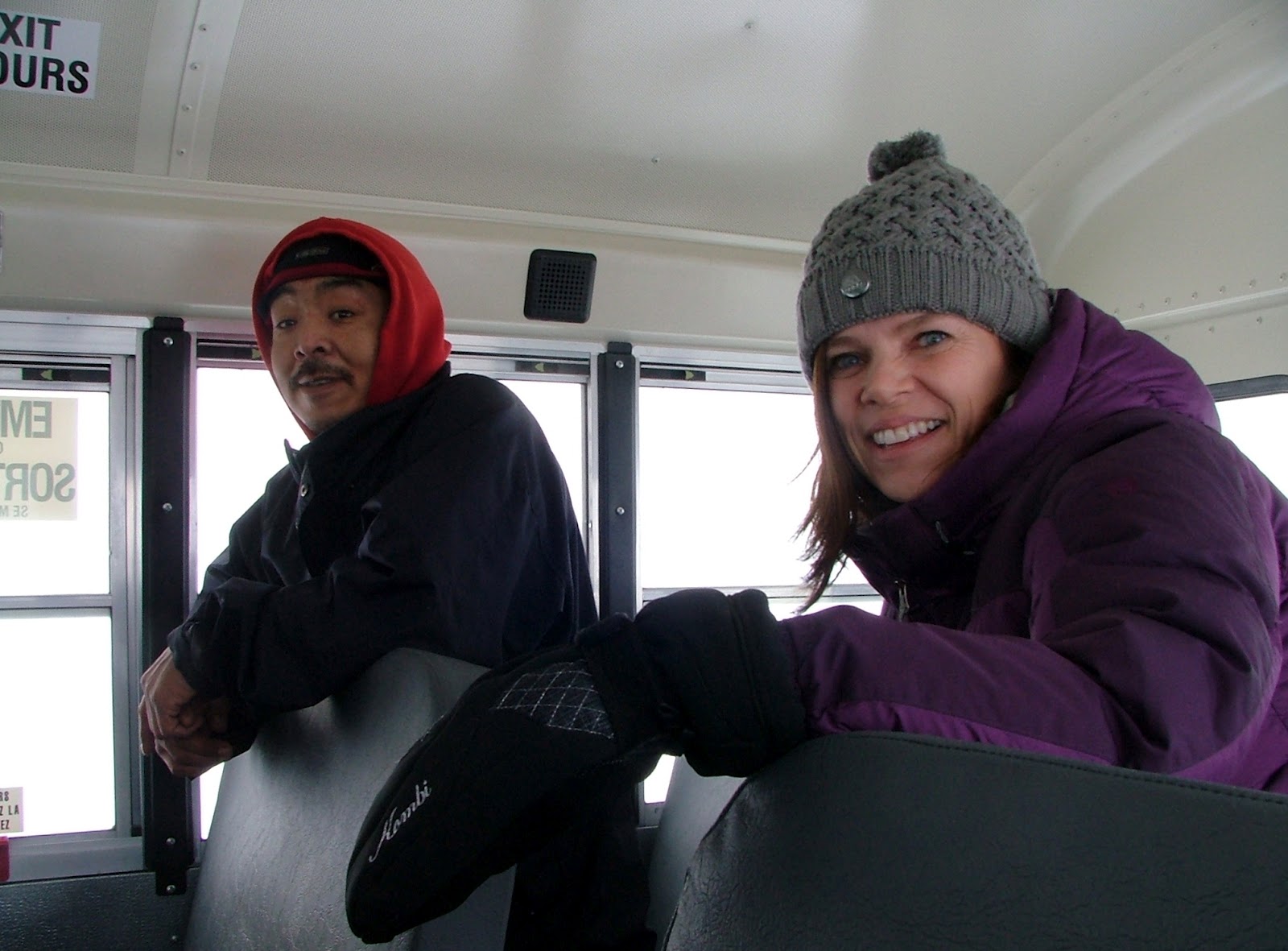
One thing that struck me about the environment up there was that every venture outside of shelter took consideration and planning. I began to watch everyone who would show up in our small cafe. Even the young people were dressed warmly. I noticed it the most with women. In Alberta most women do not wear overpants and long underwear isn't often a consideration. At times we head out with only nylons covering our legs. Our footwear is also problematic. We tend to wear shoes or stylish boots that have no insulating value at all. Not the case in Rankin Inlet. I noticed that many women wore insulated pants or track pants under their long jackets. Their stylishness was apparent in the beautiful parkas they wore. Most were adorned with lace, fringe, decals or bright complimentary colours.
The other consideration for excursions was how unreliable vehicles were at the cold temperatures. The town garbage truck lost a starter in the first few days we were up. Garbage pickup stopped. We found a truck's universal joint on the middle of the road during our walk to the restaurant. Many vehicles -- snowmobiles or trucks, would get stuck in town and groups of people would get out to push.
A snowstorm could truly threaten the town. We could see evidence of the accounts we heard. A number of residences had cleared paths in the fronts of their homes with the layers of snow cover evident. The snow was thick and hard, and some layers were up to 2 ft thick. Arnie talked about snow storms that came in so hard the houses would be covered. Water and fuel delivery would be stopped short until enough snow could be cleared to get to everyone. Not the same as the snow we see hear. The winds from the Hudson's Bay practically pack the snow down as it falls. Arnie called it perfect igloo-making snow. There was no crust with a soft inside like we might see -- it was all crust.
I enjoyed the sound it made when I walked, your steps echoed through the snow and you could tell when the thickness changed because there was a 'hollow' sound in some spots. The snow had a bluish tinge as the shadows of the day moved through the town. Very beautiful but almost impossible to capture on camera because colour differences were so small.
More to come in a few weeks. Many of our participants have been to Edmonton but there are a couple who have not ventured south very often. I'm excited to see their impression of Edmonton, but also a little worried about them. We encouraged them to stick close to each other when they were out in the evenings.
Monday, March 5, 2012

Saturday, March 3, 2012
The Meat of It
Another short post today...
Thursday was a full day of 'what to do with'. We explored the options for storage and disposal/recycling across most of the hazardous waste categories.
A few of the landfill operators have worked on crews that cleaned up mine sites within their local areas. This experience exposes them to good hazardous waste management practices and different types of technology. The Resolute Bay mine clean up project used a high efficiency incinerator that was used to burn hazardous wastes. The group had many questions about how something like this might work. While we had answers around how it could be possible, we definitely couldn't tell them how effective the incinerator was, or the likelihood of a solution like that gaining approval for more general use.
Another individual saw waste oil being burned in an open pit at a mine site. The company had been contracted to do it and they used compressors to feed oxygen to the fire. Again, we couldn't give them any indication that these solutions would be effective or acceptable from a regulatory perspective.
Their biggest question and concern is in regard to shipment of these wastes to an acceptable disposal or recycling site. They refer to the task of finding receivers to be akin to finding a needle in a haystack.
All municipalities have a requirement for a clear emergency plan. In the represented northern communities these plans seem to include risk potentials at the landfill. Everyone in the class could indicate who they would call in the event of an emergency, and how they would proceed in a fire or major spill situation. Many had actively worked with their local conservation officers to resolve community issues already.
Federal Coast Guards seem to keep spill clean up caches in most northern seaside communities. These caches are accessible by local RCMP and all course participants knew they could use this equipment in the event that they faced a major clean up.
The only question that wasn't easily resolved in this area was recordkeeping around the volume of chemical types stored on the site. While many communities had a rough idea, this information was rarely written down.
The weather has slowed down our socializing. The cold wind cuts through everything and exposed skin is painful. The wind was at our backs as we were walking back from a local restaurant last night and I was sure my calf muscles were seizing in response to the cold. I have a new appreciation for warm weather gear. My sorels are the best investment ever.
Jim and Dwayne took Arnie up on a tour about town. Their tour extended a little further than anticipated... Jim bumped his head on the door jamb getting into the truck, opening up a gash. The bleeding was bad enough that they headed to the local health centre where he was stitched up. Jim was well taken care of and the tour and evening proceeded normally. The guys headed down to the Hudson's Bay and Dwayne was excited that he stood on the Bay. I was sorry I passed up the chance. We all headed out to a local restaurant to try a local delicassy... a good feeding of Arctic Char. It is a lot like salmon but the meat is more delicate and the taste is richer.
I'll find out for sure today but this trip to Edmonton will be a first for many of our participants. They were amazed at the size of the 3 story apartment buildings in Rankin, so I am curious about how Edmonton hits them. They are interested in the hockey game and the mall. They all expressed excitement about the practical experiences they would have at the sites in Edmonton.
Today there is a craft market at the local arena. We are hoping to make it there to gain a sense of some of the local craftsmanship. Many of the ladies in the community sew jackets for their whole families. The coats are thick, expertly sewn and usually include fur pieces at the hood or the wrists. That fur is decorative in the south. In this northern weather it's functionality is clear -- it's a good windbreak that protects exposed skin.
More tomorrow... I promise!

Thursday, March 1, 2012
In the Heart of It
I slept in this morning... this will be short!
Yesterday brought us into the heart of the hazardous waste material. Our final chemical sorting activity was evidence that our group was coming along with us... and that's good news! Identification and categorization of hazardous waste products is a lot like learning English. There are a few rules to follow... but lots of exceptions. There is nothing more challenging than introducing people to a 'common approach' and then let them know that there are times when your 'common approach' can't work... Yikes! I feel good that they will also be considering this when they take the IMDG training and then again at the Eco-Station in a concrete way.
We are beginning to get great questions. I was on the internet last night (slow as molasses, so it took awhile!) researching ways to recycle used oil. One of the participants said a local resident was 'cleaning it up' to be used again and he wanted to know the possibilities in that area. I found an answer... it's possible but the quality of the oil could be a concern. They identified that their oil is 'tainted' with water and glycol so the owner of the used oil heater doesn't want to take it.
Today we are digging into Handling and Management, our heaviest section. The good news is that it's also the most interactive. I'm looking forward to a lot of questions today.
I found the fitness facility last night, I ran off some steam. It felt good. Jeff, the landfill operator from Iqaluit is in town today. He was in contact with Jim. His son is playing hockey at the local arena. His son is close to my son's age -- either 2nd year bantams or 1st year midget and he plays on Nunavut's competitive AAA team. It should be fun to watch.


Wednesday, February 29, 2012

Tuesday, February 28, 2012
Getting Started
The participants didn't know where we were or what time we were starting. That's just a small detail... lol!
We saw a small town in action and by 9am everyone arrived who would be coming for the day. Someone, somewhere in Rankin was able to direct them to the right spot. We expected 16 and saw 14. We heard that 2 individuals may have faced travel issues because one of First Air's jets needed repair up north and everything got bumped around. No one knew if they might show up late or if they may not come at all. I imagine I will see them tomorrow if they are coming.
Today was our chance to get to know the communities. Most of our morning was filled with discussion about the infrastructure, issues and trends that influenced their roles within the community. We spent the afternoon introducing solid waste concepts and good landfill practices.
My insights from the morning's discussion:
One of the fellows promised me he would teach me to sea kayak... I would love to do it! I said I heard you couldn't go out until you learned to do a roll... he asked, you mean an 'eskimo roll'? He laughed and said, no, you don't want to do that if you don't have to... I knew there was something off about the thought as soon as it came out of my mouth... I can't imagine anyone would want to get wet out here. Another fellow let me know that you would end up rolling if you were too stiff -- but if you kept a flexible body, you wouldn't have trouble. My 'teacher' takes his kayak out hunting. He says he hunts seal, bow whale and even polar bear... I asked him how he would get a polar bear home on his kayak. He said he would work day and night... I assume that means many trips? I think I'll ask him more about that tomorrow...
Arnie said the biggest polar bears live out on the ice. They wander around the edge of the flow where they can find seal and they rarely come in to land.
I was reading the paper up here today. Roald Amundsen, an early northern explorer, credited his time in Gjoa Haven for giving him the skills to make it through the Northwest Passage. The more chances I get to chat, the more I realize that there is a true 'art' required to embrace life in these northern communities. The fellow from Gjoa Haven spoke of their seasons as -- the 'light' and 'dark' season. When he mentioned that we were heading into the time of 'light' his face lit up in a way that expressed true joy.
Jim took some pictures today, I'll post them tomorrow.
We saw a small town in action and by 9am everyone arrived who would be coming for the day. Someone, somewhere in Rankin was able to direct them to the right spot. We expected 16 and saw 14. We heard that 2 individuals may have faced travel issues because one of First Air's jets needed repair up north and everything got bumped around. No one knew if they might show up late or if they may not come at all. I imagine I will see them tomorrow if they are coming.
Today was our chance to get to know the communities. Most of our morning was filled with discussion about the infrastructure, issues and trends that influenced their roles within the community. We spent the afternoon introducing solid waste concepts and good landfill practices.
My insights from the morning's discussion:
- Concern for the issues and community involvement in finding solutions is alive in many small communities. Cambridge Bay was facing public concern over a very large and unsightly dump site. They accomplished change with the help of many volunteer hours from their community members. People came out to build, clean and support any way they could.
- In a northern environment it is very challenging to do all the 'right' things. Landfill cover is a good example. Sometimes good cover (crushed rock, soil) is not available and needs to be made by crushing rock. This solution is too costly for some communities to bear.
- Polar bear control is an issue. The bears are attracted to the landfill sites. It's illegal and dangerous for them to feed at the landfill. Fencing is not effective to stop them. Some communities are burning landfill waste in an effort to deter the bears. Not the best situation, but better than the alternative.
- Historical problems are difficult to solve... some communities have commercial or industrial waste onsite that was received in the past with no way to identify it.
- Many landfills are uncontrolled.
One of the fellows promised me he would teach me to sea kayak... I would love to do it! I said I heard you couldn't go out until you learned to do a roll... he asked, you mean an 'eskimo roll'? He laughed and said, no, you don't want to do that if you don't have to... I knew there was something off about the thought as soon as it came out of my mouth... I can't imagine anyone would want to get wet out here. Another fellow let me know that you would end up rolling if you were too stiff -- but if you kept a flexible body, you wouldn't have trouble. My 'teacher' takes his kayak out hunting. He says he hunts seal, bow whale and even polar bear... I asked him how he would get a polar bear home on his kayak. He said he would work day and night... I assume that means many trips? I think I'll ask him more about that tomorrow...
Arnie said the biggest polar bears live out on the ice. They wander around the edge of the flow where they can find seal and they rarely come in to land.
I was reading the paper up here today. Roald Amundsen, an early northern explorer, credited his time in Gjoa Haven for giving him the skills to make it through the Northwest Passage. The more chances I get to chat, the more I realize that there is a true 'art' required to embrace life in these northern communities. The fellow from Gjoa Haven spoke of their seasons as -- the 'light' and 'dark' season. When he mentioned that we were heading into the time of 'light' his face lit up in a way that expressed true joy.
Jim took some pictures today, I'll post them tomorrow.
Monday, February 27, 2012
Arrival & Getting Climatized
We arrived this afternoon at 1:40pm. The flights worked out well -- for anyone ever heading this way -- First Air serves HOT MEALS, I haven't had a hot meal on a plane for so long I can't remember when! All our boxes arrived without a hiccup. It was a relief for me because I needed to identify some as 'excess' when we checked in, it was hard to say what I was OK to go without and once I had I regretted it. Jim even brought his guitar and it was the first thing unloaded -- not a scratch...
We met the crew from Cambridge Bay at the airport, very friendly! They saw Dwayne's jacket and introduced themselves to us. Mike said we have representation from the two most northern communities in Nunavut in our course... Gjoa Haven and Resolute Bay.
Arnie, the Utility Foreman for Rankin Inlet picked us up at the airport, took us to the hotel, then the fire hall (where the training will take place) and then on a guided tour of the whole town -- including the landfill, of course.
Ambrose is the fire chief and he has offered to make us coffee and bring in cookies each morning. Although he was a bit surprised by our arrival, he didn't hesitate and was ready to accomodate anything we needed. The room will be perfect -- it's spacious and equipped with everything we need.
The town of Rankin has over 2000 people and 847 vehicles. Many people use all terrain vehicles or snowmobiles as their primary means of transportation. It seems weird for snowmobiles to plow along the main street amongst the cars... but why not?
The town has an underground utilidor serving water to a large section of the community. Unlike Iqaluit, Rankin has a little more topsoil, gravel and crushed rock around. The utilidor is contructed from a material that has some flexibility in order to deal with shifts in the permafrost.
Tomorrow we will be talking about the landfill in each of the communities attending (12) and touring Rankin's landfill with the participants. I can't wait to hear more about the conditions everyone faces.
More tomorrow...
Sunday, February 26, 2012
Municipal Hazardous Waste - 2 in Rankin Inlet
Here we go again!
The Edmonton Waste Management Centre of Excellence is working with the Municipal Training Organization and the Department of Environment for Nunavut to bring Municipal Hazardous Waste Training to municipalities across the north. This time 16 individuals from 12 northern communities will participate in 11 days of training -- 5 in Rankin Inlet and 6 in Edmonton, where they will explore methods to manage hazardous waste within their community landfills.
Jim Lapp, Dwayne Christenson and myself (Colleen Starchuk) will head to Rankin Inlet tomorrow. Training participants will venture to Edmonton for the 2nd phase of their training experience on March 25.
While we can never be sure until we begin discussions, the training team recognizes that 'waste management' in these remote communities is a different ballgame than it is in the south. As we found out from our last trek, a rocky land mass, limited shipping opportunities and year round ground frost are just some of the factors that make 'typical' methods impossible.
As before, the only thing we can all be sure of is that this northern trek will provide us as much learning as we are hoping to provide. Our last foray exposed us to rich culture, a strong sense of community and greater perspective about the challenges of supporting a remote community.
More to come as the adventure unfolds...

Saturday, February 19, 2011
HHW Last Day!
Our last day of training, but definitely not an easy one. We tackled a preview of Ozone Depleting Substances today, moving through some concepts that we were even questioning as instructors.
Full agreement by everyone: the best part of the day was the giveaways. Thanks to Steve's generosity we gave away the safety gear and the remaining prizes. The gear put a smile on everyone's face and created a lot of excitement in the room.
As a wrap-up we talked about some of the things that the participants felt they could do in their communities now. Here are some of the answers we received:
So far we have received kudos for supporting this training initiative. Initial feedback is very positive and impressions should only gain strength after participants have a chance to see different ways to accomplish the work we discussed on their tours in Edmonton. We may not see everyone in Edmonton, but it isn't due to a lack of interest. Some participants have other commitments that will keep them from coming, but there is strong interest in the opportunity overall.
Jim and I spent some time shopping this afternoon. As we trekked through the -25 temperatures we chatted about our impressions and experiences. We definitely agreed that we were all learning in that classroom. Jim, Steve and I have a much better understanding of the implications of life without some of those basic services, utilities and infrastructure that we tend to take for granted now than we did before we got here. Things that we imagined would be very simple are actually very complex in this environment. We also agreed that it would be wrong to assume that a lack of forward movement was due to a lack of interest or concern. We definitely got the impression that everyone in the room was passionate about doing the best they could.
I've included a few pictures...
Full agreement by everyone: the best part of the day was the giveaways. Thanks to Steve's generosity we gave away the safety gear and the remaining prizes. The gear put a smile on everyone's face and created a lot of excitement in the room.
As a wrap-up we talked about some of the things that the participants felt they could do in their communities now. Here are some of the answers we received:
- Improve my storage practices, I've cleaned a lot up, but I can still improve some of the sorting and storage steps I've taken.
- Begin talking to Town Council and community members about the important things we need to address.
- Talk to my landfill operators and find out what we are doing with these hazardous wastes.
- Begin making the changes to the bylaws and to the rules at our landfill so we can begin talking to the businesses about their responsibilities to manage their own hazardous wastes.
- I will put up signs saying that dumping is illegal. Then I can deal with the situations that happen.
- I want to get my community involved in cleaning some of the problems up. This impacts our land, our animals and our children.
- I will deal with my waste batteries. I know I can get them prepared for storage and shipment and then begin the work to find a receiver.
- I want to continue to raise awareness. I think that we can get the community involved in changing the way they handle household hazardous wastes.
- I want to extend my battery collection program to include another product.
So far we have received kudos for supporting this training initiative. Initial feedback is very positive and impressions should only gain strength after participants have a chance to see different ways to accomplish the work we discussed on their tours in Edmonton. We may not see everyone in Edmonton, but it isn't due to a lack of interest. Some participants have other commitments that will keep them from coming, but there is strong interest in the opportunity overall.
Jim and I spent some time shopping this afternoon. As we trekked through the -25 temperatures we chatted about our impressions and experiences. We definitely agreed that we were all learning in that classroom. Jim, Steve and I have a much better understanding of the implications of life without some of those basic services, utilities and infrastructure that we tend to take for granted now than we did before we got here. Things that we imagined would be very simple are actually very complex in this environment. We also agreed that it would be wrong to assume that a lack of forward movement was due to a lack of interest or concern. We definitely got the impression that everyone in the room was passionate about doing the best they could.
I've included a few pictures...
 |
| Hilda, Sam and Jamessee work in the foreground, Greg, Dennis, Shawn and Don in the background. |
 |
| Cold, wind and snow outside our classroom. |
 |
| Iqaluit from the best viewpoint in the city. Nice, clear day. |
HHW -- Day 3 and 4
These were our meatiest days. We plowed through descriptions, how-to's and activities around hazardous waste management. We discussed many situations that were challenging for local landfills. Most participants could provide a story where hazardous materials were dumped illegally on their sites. Many were left to manage commercial products that will be difficult and costly to deal with. One of the most prevalent hazardous wastes for northern communities are their waste batteries. They all report having many of these and they have no option but to store them. They have not found an appropriate recycler and are uncertain of what steps they will need to take to ship the batteries away, but many are very keen to find these solutions.
While there is much interest in the requirements we have discussed, many communities are not currently in a position to begin taking the steps required. One of the greatest barriers they see is the cost that will be associated with shipping these waste products out.
It has been good to witness the types of discussions that help community representatives understand systemic issues more clearly, share solutions and their personal wisdom gained through their experiences. If there was one indirect gain from this training, I believe it could be the birth of a loose support system where the participants begin to see that there are other people who can support them. This, in itself, may help these communities to face the challenges that are ahead.
Below are a few pictures of everyone hard at work...
Thursday, February 17, 2011
HHW - Day 2
We are settling in although the weather surprised us a bit. Our short walk from hotel to training site seemed like a mile-long trek because a cold wind was pushing against us the whole way. Scarves are cool in Iqaluit and most people use them for what they are intended for -- far from decorative!
Our focus today was on regulations and an intro to hazardous wastes. Things happen quickly in small communities... Before lunch the students expressed interest in talking to the representative from INAC who does their inspections. Jeff from Iqaluit knew him well and had convinced him to come in and answer our questions by the afternoon. It was a great opportunity to get some of the specific concerns addressed that everyone had.
We heard that one of the most unexpected way that hazardous wastes were received was inside a whale carcass. As the rib cage opened -- 3 paint cans were revealed... Things can take you by surprise up here...
We are beginning to hone in on the things that may be possible for many communities. They are really interested in finding solutions to the problems that plague them but there are many barriers to making things happen.
Today will be a focus on recognizing household hazardous wastes and handling hazardous wastes. We are hoping there are lots of great takeaways from this...
We haven't needed to stray far yet. Each night in the hotel restaurant a number of people come in to show us their creative work -- prints, carvings, sealskin mitts, etc. It is all very beautiful, is a lot less than what you would find in the stores and we don't need to leave the warmth of the hotel.
We had a chance to find out about whale hunting over the coffee break yesterday. Whale hunting is so common that whale carcasses are the number one item that attracts polar bears to the dump. Whale hunters head out on the ocean in 15 foot sea canoes. They use harpoons to spear the whales and sometimes a rifle. Talk about up close and personal with an animal that's bigger than you and your boat! Hard to imagine who ever thought that might be a good idea. Lots of courage!
Stay tuned -- I have a great picture of our blizzard-like conditions yesterday to post, just can't do it now.
All for now!
Wednesday, February 16, 2011
HHW -- Day 1 Review
As we began the day we told the class that we expected to learn as much as they would, that our understanding of the conditions they lived and worked in were minimal and that we wanted to help them to see the possibilities that would be a good fit for their situation. We were very right about the learning we would encounter. As the participants shared the real conditions that they worked under we began to see how challenging our work would be. Here are some examples of what we found out:
The Iqaluit dump tour provided good framework for some of the opportunities that smaller municipalities might have. I've included a couple pictures below:
- Polar bears can arrive at the landfill site in great numbers -- participants from Whale Cove provided accounts of 7 or more at a time. When this happened they shut down the dump until the bears left. A man would risk his life if he stepped out of a truck near polar bears. There is no fear of humans. They tried to scare away the bears with rubber bullets, etc., but they often came back. The bears ripped down their fences...
- The landfill operators also care for the sewage lagoons and water treatment. Most towns require that water and sewage be trucked to and from homes. Most homes have a large tank inside for each of these liquids. During blizzards water delivery grounds to a halt and residents may be required to go without water. These types of emergency situations distract from landfill and waste collection activities.
- Burning garbage is one of the most commonly used methods for reducing the mass of household garbage brought to the dump. The sites that faced the most issues identified situations that prevented them from burning. One site was too close to the airport and the smoke from the dump would keep planes from landing. All sites struggled to burn due to changing winds and issues with the smoke moving towards town.
- Most household garbage reaches the dump through collection. Businesses and commercial groups haul their own garbage to the dump. Many groups talked about having special sections of the dump set up for commercial groups to segregate hazardous wastes, metals, tires, etc.. This segregation was sometimes done by dump employees or commercial groups were asked to clean up or move waste that was dumped inappropriately.
- One of the biggest factors that came up is that many struggled to meet community needs with the level of funding they had available. When they considered investment in what they needed to properly manage their waste, they felt like they needed to reallocate money from other essential services.
The Iqaluit dump tour provided good framework for some of the opportunities that smaller municipalities might have. I've included a couple pictures below:
 |
| Jim in front of the large mound of household waste. |
 |
| A great landfill sign! |
 |
| This is the metal storage site -- some is compacted. |
 |
| Jamesee in front of the household mound from another angle. |
Monday, February 14, 2011
We Made It!
This is a short note to let everyone know that we made it -- along with our load of boxes! There was one casualty, Jim has not seen his luggage yet... We are still hopeful he will see it tomorrow, but that leaves him without his winter gear. Good thing he is a tough Prairie boy! The class will be quite close to our hotel. Truly walking distance, but also a $6 cab ride away. Everywhere in Iqaluit is $6 per person...
Jamesee and Liz met us at the airport and drove us into town (5 minutes), and helped us unload our boxes into the classroom.
The classroom is an oversized boardroom with nice big chairs and it's fully equipped with all the technology we will need.
Here are a few pictures... 1st picture: Jim and Steve with our treasured boxes at 11pm last night in Toronto. Notice Jim's jean jacket -- that's what he'll be wearing until he gets his luggage or gives in and buys some big winter parka up here. I hope the luggage comes... 2nd picture: The view from my hotel room window at 4pm, just about dark...


Sunday, February 13, 2011
8 Hours Away!
In 8 hours we begin the long journey (18 hours in transit) to Iqaluit.
The work began months ago and Janice Isberg has been leading the charge. The baton has recently been passed to the delivery team. Steve Simon, Jim Lapp and I (Colleen Starchuk) are armed with all of Janice's planning and good work as we step into a 5 day Hazardous Waste Workshop designed to support communities in the far north. The very far north... Iqaluit is the gathering point and 5 other northern communities from the territory of Nunavut will participate. Our commitment to our team is to bring everyone's hard work to life and make it relevant for our participants.
As we step into this adventure our greatest hope is that the knowledge, practices and advice that we have to offer from our vantage point below the treeline can be adapted to life in the far north. We know we will be on a steep learning curve as we consider the unique circumstances that our participants face in their own communities and we fully expect that we will need to 'think outside the box' as we reflect on what they face.
This blog is an opportunity to document our experiences and learning as well as keep our extended team in Edmonton informed as we progress through the next 5 days.
We will be leaving Edmonton's balmy +1 C later today and arriving in Iqaluit to face a temperature somewhere between -27 and -35 C. We will see 8 hours and 38 minutes of sunlight, a pleasant surprise for me as I'm excited to see what life is like in this northern town.
All for now!
Colleen
Subscribe to:
Posts (Atom)